How much is 15 minutes a day over a year?
15 minutes a day adds up to 105 minutes a week and 91.25 hours over a 365-day year: 91 hours and 15 minutes, or just over 3.8 full 24-hour days.
Start on the webAlso available on iPhone and Android.
The arithmetic: from a quarter hour to a year
- One week: 15 × 7 = 105 minutes = 1 hour and 45 minutes.
- One year: 15 × 365 = 5,475 minutes; 5,475 ÷ 60 = 91.25 hours.
- In full days: 91.25 ÷ 24 ≈ 3.802 days.
These totals assume the activity happens every day for the stated number of days. A 366-day year adds one more quarter hour, making 91.5 hours; a 52-week calculation covers only 364 days and gives 91 hours.
For a schedule with days off, multiply by the number of sessions you actually plan. For example, five 15-minute sessions a week for 52 weeks total 3,900 minutes, or 65 hours.
Daily minutes compared: 10, 15, 30 and 60
Weekly figures use seven days; annual figures use 365 days. Repeating decimals are rounded to two decimal places.
| Minutes a day | Minutes a week | Hours a year | 24-hour days a year |
|---|---|---|---|
| 10 | 70 | 60.83 | 2.53 |
| 15 | 105 | 91.25 | 3.80 |
| 30 | 210 | 182.5 | 7.60 |
| 60 | 420 | 365 | 15.21 |
The days column is a unit conversion, not a promise of uninterrupted days off. Separate daily sessions can suit reading or practice, while a task that needs a long setup may benefit from fewer, longer blocks.
What that time could become
Choose one use for the quarter hour and define a small output before starting. These are illustrative allocations, not predictions of how much anyone will learn or finish.
- Reading: use 8:30–8:45 PM for a chapter section and mark where to resume; the annual total describes time spent reading, not a guaranteed number of books.
- Music: use 6:00–6:15 PM to practise one passage, then note which bars to revisit in the next session.
- A personal project: use 7:45–8:00 AM to draft one paragraph or sort a small set of photos, leaving the next action ready.
Those are alternatives for the same block. Putting all three into a day would require 45 minutes, so choose the one that matters to you and find its place in a time budget.
Make the total reflect the sessions you did
Name the activity and place a block
Pick a specific start and finish that fit your commitments, such as 8:30–8:45 PM. If the day is already full, decide which existing allocation will become shorter.
Record the time spent
Write down the actual minutes after the activity, including a shorter session when that is what happened. A scheduled block is an intention; it becomes logged time only when you enter it.
Review the difference
Seven planned quarter hours equal 1.75 hours, but four completed sessions equal 1 hour. Use the 45-minute shortfall to decide whether to move the next block or reduce the target.
For any number of completed sessions, calculate logged hours = sessions × minutes per session ÷ 60, adding different session lengths separately. Missing ten quarter-hour sessions reduces the 365-day projection by 2.5 hours, to 88.75.
See small amounts of logged time add up in Daylight
Create a goal with a color and target hours, then place blocks across all 24 hours in 15-minute steps, from 15 minutes to 8 hours per block.
Daylight logs the time you enter against a goal, with an optional note. You can edit or delete entries, so the record can reflect the time you actually spent.
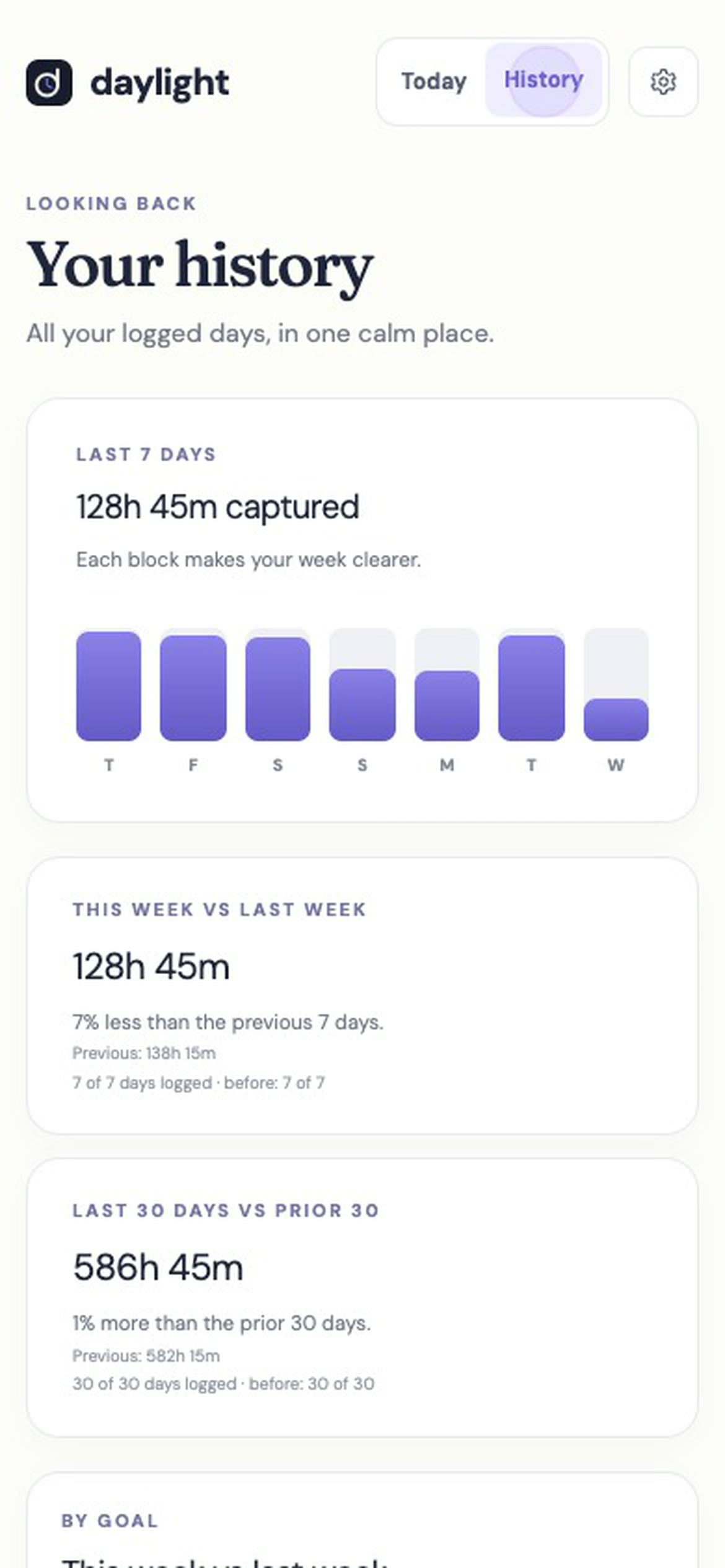
History compares this week with last week and the last 30 days with the 30 before. Use those comparisons to see how your entered sessions add up across each period; the annual figures above are arithmetic projections, not an annual History view.
Daylight Pro is $4.99 a month or $39.99 a year, plus applicable sales tax, with a 14-day free trial. There is no free plan: a valid payment method is required, and charging starts after the trial unless you cancel.
Sources
Read November 18, 2026. The calculations and activity examples are original worked illustrations; no population statistics or research-based performance claims are used.
- Daylight home page — goals, target hours, block sizes, entered time, History and trial pricing.
- Daylight time blocking guide — product workflow and subscription terms.
- Daylight guide to changing time allocations — shared guide structure and price line.