How to make time for family.
To spend more time with family, agree on one shared routine, protect its start and end, and choose a weekend anchor everyone can attend. Put those blocks into the week before optional commitments, then compare the hours you planned with the time you actually spent together.
Start on the webAlso available on iPhone and Android.
Schedule family time with three kinds of blocks
Protect a specific window
Ask the people involved which times work, then name an activity and a start and end: Tuesday 6:30–7:30 PM for dinner together. Decide which optional task will move to make room, and agree how to handle a necessary late shift or appointment.
Build together-time into a shared routine
Try breakfast, preparing a meal or an evening walk that already fits the day. For example, reserve Monday through Friday 7:00–7:30 AM for breakfast together; check that travel and getting ready still have their own time.
Choose a weekend anchor
Keep Saturday 10:00 AM–12:30 PM for an outing, a game or cooking together. Choose a nearby or at-home alternative before the weekend, so travel, weather or cost need not cancel the whole window.
Family can mean the people you live with or relatives elsewhere. A mutually agreed call can be a block too; the schedule should reflect their availability as well as yours.
If fixed commitments already fill the day, start with a smaller window or agree on a commitment to share, move or stop. Use the time budget guide to fit family blocks alongside sleep, work, care, meals and travel.
A worked week: 12 target hours, 10 actual hours
This fictional example counts only the selected family blocks, not every hour of the week. Each minute belongs to one block; a shared meal counts once, even when several relatives attend.
| Day | Target (h) | Actual (h) | Gap (h) |
|---|---|---|---|
| Monday | 1.5 | 1.5 | 0 |
| Tuesday | 1.5 | 1 | −0.5 |
| Wednesday | 1.5 | 1.5 | 0 |
| Thursday | 1.5 | 1 | −0.5 |
| Friday | 1.5 | 1.5 | 0 |
| Saturday | 2.5 | 1.5 | −1 |
| Sunday | 2 | 2 | 0 |
| Total | 12 | 10 | −2 |
Each weekday target combines the half-hour breakfast with 6:30–7:30 PM together. Saturday uses the weekend anchor; Sunday adds 4:00–6:00 PM for a visit or call and a shared activity.
Gap is actual minus target. Tuesday and Thursday each lost half an hour to late work, and Saturday lost an hour to travel: 0.5 + 0.5 + 1 = 2 hours short.
For next week, move the two evening blocks to 7:00–8:00 PM if everyone is available, and choose the at-home Saturday option. Keep the 12-hour target only if the revised blocks fit; otherwise agree on fewer hours instead of borrowing from necessary commitments.
A checklist before the week starts
- Have the people involved agreed on the activity and time?
- Does every family block have a start, an end and room around it for travel or preparation?
- Which optional commitment will give up space for the added hours?
- Have you kept essential care, sleep, work and meals in the plan?
- Is there a fallback for a missed evening or a changed weekend?
- Have you chosen a short Sunday review to compare target and actual time?
At that review, ask what everyone wants to repeat or change. More logged hours do not tell you whether the activity suited the people taking part.
Set a family goal in Daylight and review the hours
Create a Family goal, choose its color and set target hours. For the example week, assign weekday targets of 1.5 hours, Saturday 2.5 and Sunday 2, then place the agreed blocks across the day in 15-minute steps.
After a block, enter the time you spent against that goal, adding a note such as “late work” when useful. Daylight logs the time you enter; use actual time rather than copying the planned duration.
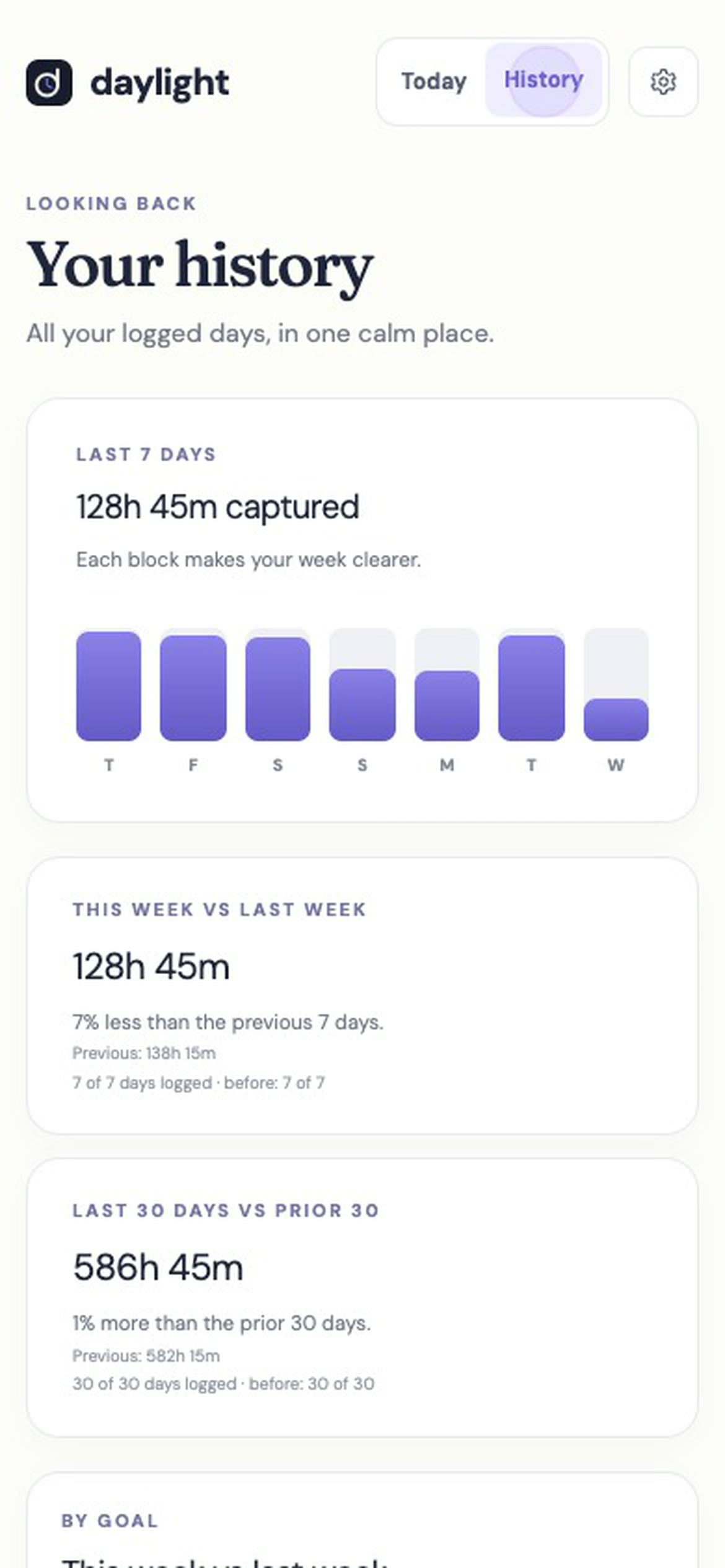
History compares this week with last week and the last 30 days with the 30 before. If last week had 8 entered family hours and this week had 10, the increase is 2 hours, while this week is still 2 hours below the example target.
Use the comparison to decide which block to keep or move, then discuss the next plan with your family.
Daylight Pro is $4.99 a month or $39.99 a year, plus applicable sales tax, with a 14-day free trial. There is no free plan: a valid payment method is required, and charging starts after the trial unless you cancel.
Fit family blocks around a school day
Our parent time blocking guide places school runs, work and family routines around flexible interruption windows.
Sources
Read November 18, 2026. The scheduling advice, checklist and worked week are original illustrations, not population statistics or research-based outcome claims.
- Daylight home page — goals, target hours, entered time, History and trial pricing.
- Daylight time blocking guide — block sizes, product workflow and subscription terms.
- Daylight guide to stopping wasted time — guide structure, Sources and price wording.