How to get more time for reading.
Choose 15 minutes you can take from an optional activity, attach reading to something already in your day, and leave your book ready there. Start with one block after breakfast or dinner, then check what you actually read before adding more time.
Start on the webAlso available on iPhone and Android.
Find a reading slot that already fits
Look at tomorrow’s fixed commitments first, including meals, care, travel and sleep. Choose one optional block to shorten: for example, replace the first 15 minutes of evening browsing with a chapter, rather than adding reading after an already full evening.
Keep the book at the place you will read and choose the next starting page beforehand. If no optional time remains, try a shorter session or move another commitment; do not assume a new goal creates extra hours.
For a whole-week allocation before placing your reading blocks, use the time budget guide.
Worked reading math: minutes a day into books a year
Read a few pages at your comfortable pace and divide pages completed by minutes spent. For an illustrative pace of 5 pages in 10 minutes, 5 ÷ 10 = 0.5 pages per minute; this is an assumption for the examples, not a population reading-speed claim.
Books per year = pages per minute × minutes per day × days read per year ÷ pages per book. The table assumes 365 reading days and 300-page books; book lengths, difficulty and your pace will change the result.
| Daily minutes | Pages per day | Annual arithmetic |
|---|---|---|
| 10 | 0.5 × 10 = 5 | 5 × 365 ÷ 300 ≈ 6.1 books |
| 15 | 0.5 × 15 = 7.5 | 7.5 × 365 ÷ 300 ≈ 9.1 books |
| 30 | 0.5 × 30 = 15 | 15 × 365 ÷ 300 ≈ 18.3 books |
Those decimals are book-length equivalents, not promised finished books. If you read for 15 minutes on five days each week over 52 weeks, the same pace gives 0.5 × 15 × 5 × 52 = 1,950 pages, or 1,950 ÷ 300 = 6.5 book-length equivalents.
Use time as the commitment and pages as an estimate. A demanding chapter may take the entire block without matching the table, and that still counts as time spent reading.
When to read: choose an anchor in your day
- After breakfast: use the gap before departure only if getting ready and travel already have enough room.
- After lunch: reserve part of an available break and keep the book within reach.
- During a passenger journey: use a seated bus or train segment when reading is practical; keep driving and walking separate.
- After dinner: swap a defined slice of optional screen time for reading before starting the rest of your evening.
Pick one anchor and a fallback, such as after dinner when the morning runs late. Move the block rather than counting both slots as completed, and stop at the planned end if another commitment follows.
A sample reading week: 2 target hours
This fictional plan reserves 120 minutes by replacing optional browsing or open leisure time. The logged column illustrates what someone entered after each session; it is not measured usage data.
| Day and anchor | Planned minutes | Logged minutes |
|---|---|---|
| Monday, after breakfast | 15 | 15 |
| Tuesday, after dinner | 15 | 10 |
| Wednesday, after lunch | 15 | 0 |
| Thursday, after breakfast | 15 | 15 |
| Friday, after dinner | 15 | 20 |
| Saturday, after breakfast | 30 | 30 |
| Sunday, after lunch | 15 | 15 |
| Total | 120 | 105 |
Planned time is 6 × 15 + 30 = 120 minutes = 2 hours; logged time is 15 + 10 + 0 + 15 + 20 + 30 + 15 = 105 minutes = 1.75 hours. The shortfall is 120 − 105 = 15 minutes, or 0.25 hours.
Check why Wednesday’s slot disappeared before changing next week. If lunch is routinely occupied, move that quarter hour to an available evening; if no replacement fits, reduce the target instead of borrowing from essential time.
Reading-time statistics are context, not a quota
The BLS American Time Use Survey’s 2025 annual averages report 0.27 hours of leisure reading per day for the civilian population aged 15 and over: 0.27 × 60 = 16.2 minutes. This population average includes people who did not read that day; it is not the average session length among readers or a recommended daily target.
Your available minutes are the useful starting point. The worked schedules above are original examples, separate from the survey estimate.
Plan a reading goal and review entered time in Daylight
Create a Reading goal with a color and target hours, using the sample week’s 2 hours as your planning amount. Place its blocks around your commitments across the full 24-hour day; blocks run from 15 minutes to 8 hours in 15-minute steps.
After reading, enter the time spent against that goal and add a note such as the chapter you reached. Daylight logs the time you enter, so record the actual 10-minute session even when its planned block was 15 minutes.
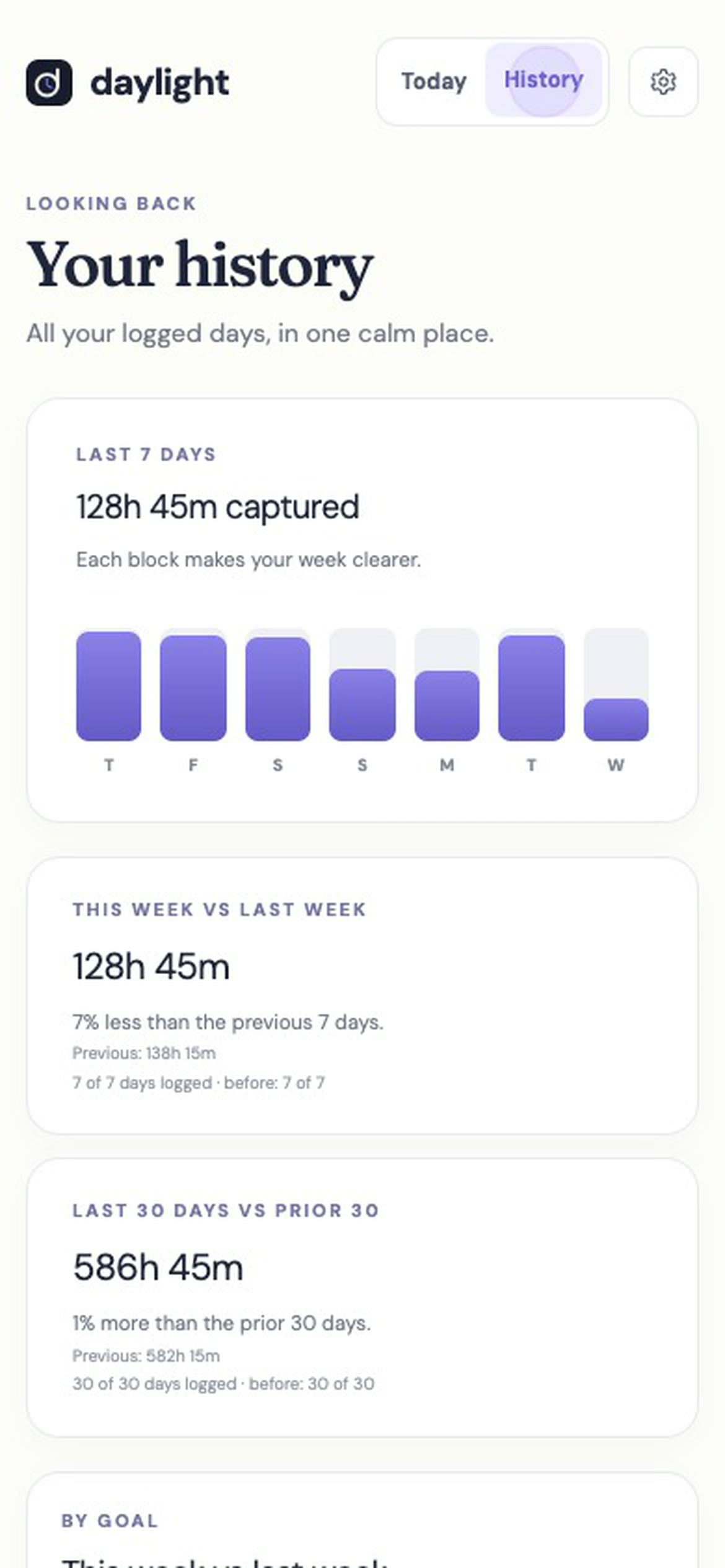
Compare planned and logged hours to see the sample week’s 2-hour intention beside 1.75 hours entered. History compares this week with last week and the last 30 days with the 30 before; use those comparisons to decide whether to move a block or adjust your target.
Daylight Pro is $4.99 a month or $39.99 a year, plus applicable sales tax, with a 14-day free trial. There is no free plan: a valid payment method is required, and charging starts after the trial unless you cancel.
Sources
Read November 18, 2026. Reading plans and book calculations are original illustrations; the survey statistic and product details were checked against these pages:
- BLS American Time Use Survey, Table 11A: 2025 annual averages — leisure reading hours for people aged 15 and over; updated June 25, 2026.
- BLS American Time Use Survey technical note — population averages include respondents who did not do the activity on their diary day.
- Daylight home page — goals, target hours, block sizes, entered time, History and trial pricing.
- Daylight time blocking guide — planning workflow and subscription terms.
- Daylight guide to changing a time block — shared guide format and price line.