What should I do with my free time?
Choose one thing you said matters: time with someone, learning something, making something or simply enjoying yourself. Match it to the time you have, then give it a start and an end: read for 15 minutes, practise for an hour or spend an evening with a friend.
Start on the webAlso available on iPhone and Android.
Things to do with free time, by length
Pick an option that fits the whole gap, including getting ready, travel and putting things away. These are choices, not extra tasks to add all at once.
15 minutes
Read a few pages, sketch one object, listen to a song without doing anything else or call someone for a short catch-up. Keep a book or sketchbook nearby so preparation does not take the entire slot.
An hour
Practise a song on an instrument, cook a recipe with ingredients you already have, work through a lesson or play a board game. Choose one small stopping point, such as learning the chorus rather than mastering the whole piece.
An evening
Share dinner with a friend, watch a film you chose in advance or spend two hours on a personal project. Agree on the time with anyone involved before setting the evening aside.
A weekend
Visit a nearby museum, make a small piece of furniture or plan a day trip within your budget. Reserve specific parts of the weekend for it and leave room for meals, chores, travel and open time.
How should I spend my free time? Start with what matters
Use your own priorities to narrow the list. Finish this sentence: “I keep saying I want more time for ___.” Choose one answer for this week, then ask:
- What would count as time well spent? Name an activity you actually want, such as playing guitar or seeing a particular friend, rather than choosing something only because it sounds productive.
- What fits the gap and the budget? Check the time available after commitments and include any cost, equipment or travel. If you have 15 minutes at home, choose an activity that can start there.
- Do I want company or time on my own? Make the invitation first if the activity needs another person; keep a solo option available if they cannot make it.
- What will I leave open? You can choose a quiet evening without giving every minute a task. Only reserve the blocks you want to protect.
If you are unsure how much time is available, use the time budget guide to account for commitments before choosing new activities.
A worked week: two activities in three hours
In this fictional example, you want to play guitar and spend time with a friend. After existing commitments, you have one free hour on Tuesday and three on Saturday evening; you reserve three of those four hours and leave one open.
| Block | Activity | Planned (h) | Logged (h) |
|---|---|---|---|
| Tue 7–8 PM | Practise guitar | 1 | 0.75 |
| Sat 6–8 PM | Dinner with a friend at home | 2 | 2.25 |
| Activity totals | 3 | 3 | |
Tuesday’s practice ended at 7:45 PM, leaving 15 minutes unused in that block. Saturday’s dinner ran until 8:15 PM, using 15 minutes of the hour left open after dinner; 45 minutes of that evening stayed unplanned.
The activities total 1 + 2 = 3 planned hours and 0.75 + 2.25 = 3 logged hours. The total matches, but guitar received 0.25 hours less and dinner received 0.25 hours more, so review each activity rather than relying on the combined number.
For next week, keep the same practice slot if the shorter session was a one-off; shorten it to 45 minutes if that is the time you want to spend. Ask your friend before reserving another dinner, and choose a different activity for that slot if they are unavailable.
Plan the blocks and log what happened in Daylight
Create a goal for each chosen activity, give it a color and target hours, then place its blocks around the commitments already in your day. Daylight supports all 24 hours, with blocks from 15 minutes to 8 hours in 15-minute steps.
After each activity, enter the time you spent against its goal and add an optional note. Daylight logs the time you enter; in this example you would enter 0.75 hours for guitar and 2.25 hours for dinner.
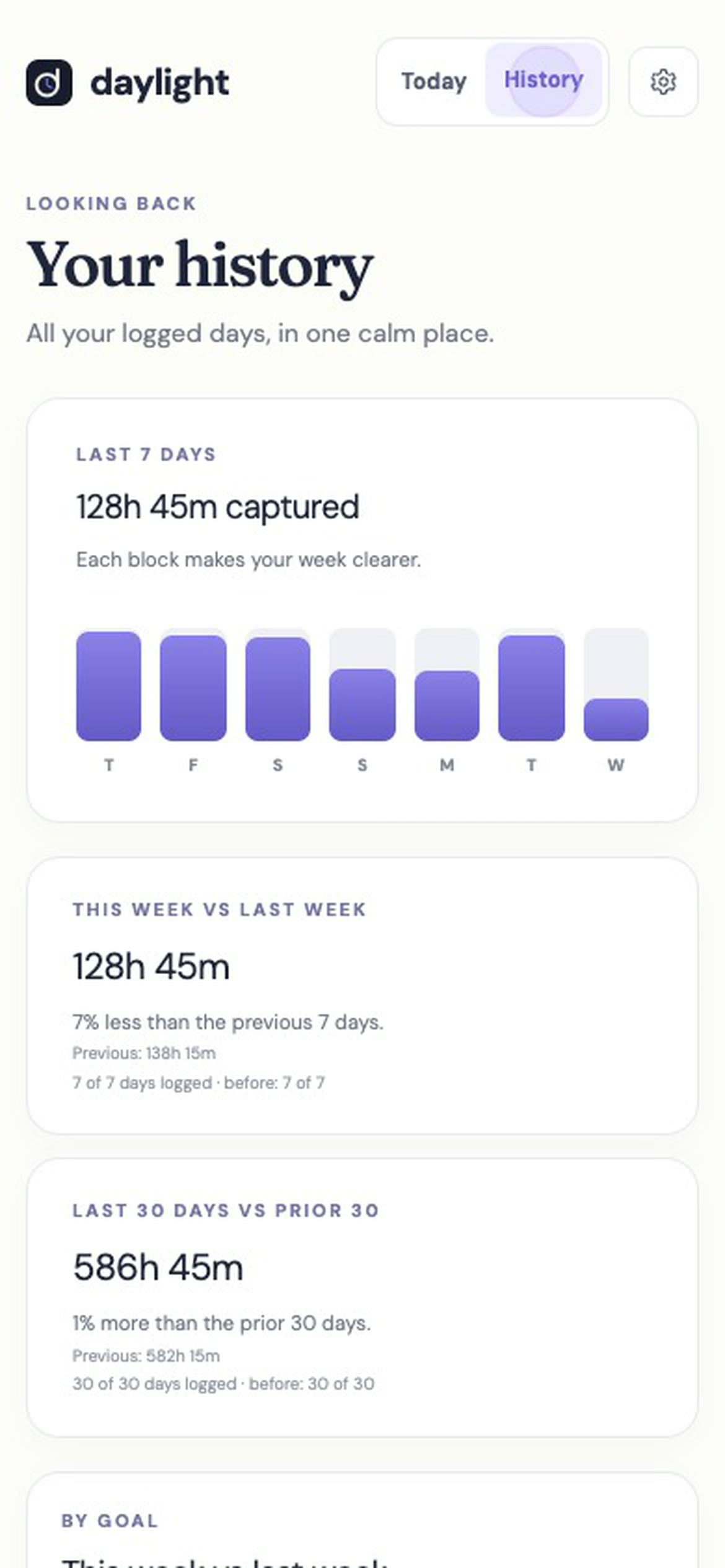
History compares this week with last week and the last 30 days with the 30 before. Use those comparisons alongside your plan to decide whether the activities you chose are receiving the hours you intended.
Daylight Pro is $4.99 a month or $39.99 a year, plus applicable sales tax, with a 14-day free trial. There is no free plan: a valid payment method is required, and charging starts after the trial unless you cancel.
Sources
Read November 18, 2026. Activity suggestions and the worked week are original illustrations; no population statistics or research-based outcome claims are used.
- Daylight home page — goals, target hours, block sizes, entered time, History and trial pricing.
- Daylight time blocking guide — planning and logging workflow and subscription terms.
- How to stop wasting time — guide structure, Sources format and price line.