Where does my day go?
Your day can fill with small tasks and gaps you never planned: four 15-minute pieces use an hour. For three days, plan your hours, log what you actually do and compare the difference, including meals, travel, care and downtime.
Start on the webAlso available on iPhone and Android.
Why a day can disappear into small tasks
A plan may name work and appointments but leave out getting ready, making lunch, tidying up or waiting between commitments. A short task can also take longer than the space you gave it, pushing the next activity later.
Separate time you chose, necessary commitments and hours you cannot yet explain. Leave unknown time marked “unrecorded” until you have evidence; do not assume every gap was browsing or every hour outside work was wasted.
How 15-minute pieces add up over a day, week and year
Imagine four separate 15-minute pieces: checking messages after breakfast, finding a misplaced item, an extra errand and browsing before dinner. This is a fictional illustration, not a measured average or a promise of time saved.
| Period | Arithmetic in minutes | Hours |
|---|---|---|
| Day | 4 × 15 = 60 | 60 ÷ 60 = 1 |
| Week | 7 × 60 = 420 | 420 ÷ 60 = 7 |
| Year | 365 × 60 = 21,900 | 21,900 ÷ 60 = 365 |
The week assumes the same four pieces every day, including weekends; the year uses 365 days, not 52 rounded weeks. If this happens only on five workdays, the weekly total is 5 × 60 = 300 minutes, or 5 hours.
Only count separate pieces once. If you check messages while waiting for an errand, those overlapping minutes belong to one main activity in this calculation.
How Americans spend a day: BLS 2025 averages
The Bureau of Labor Statistics released its 2025 American Time Use Survey results on June 25, 2026. Table 1 reports these daily averages for the civilian population age 15 and over:
| Activity | Hours per day |
|---|---|
| Personal care | 9.80 |
| Eating and drinking | 1.21 |
| Household activities | 1.99 |
| Work and related activities | 3.32 |
| Leisure and sports | 5.16 |
| All remaining categories* | 2.52 |
| Total | 24.00 |
*Calculated remainder: 24 − (9.80 + 1.21 + 1.99 + 3.32 + 5.16) = 2.52 hours. Sleep is included in personal care, so adding it again would double-count it.
These averages include all days and people who did none of a given activity, including people without jobs; they are not a recommended schedule or a typical employee’s working day. The survey records the main activity when activities overlap.
BLS cautions that the 2025 shutdown interrupted collection and may have affected estimates; missing dates were represented through weighting. Use the figures as context for your own record.
Where does my free time go?
“Free time” may mean everything outside paid work, or only the hours after meals, care, travel and chores. Choose a definition before comparing days, so an evening of necessary errands does not look like unexplained leisure.
For example, a fictional 6-hour evening can contain 1 hour of travel, 1.5 of meals and care, 0.5 of chores and 3 of chosen leisure: 1 + 1.5 + 0.5 + 3 = 6. If your plan expected 4 hours of leisure, the missing hour came from the allowance for other activities.
A 3-day check: plan, log, compare
Plan before each of the three days
Assign the full day to broad areas, starting with fixed commitments, sleep and everyday tasks. Keep a named allowance for gaps; for a complete recording method, use the time audit guide.
Log what happened throughout each day
Enter time after activities or at a few review points, using the same area names as the plan. Include short tasks and transitions, note uncertain estimates and reconcile to 24 hours without counting simultaneous activities twice.
Compare at the end of day three
For each area, subtract planned hours from logged hours; positive means extra time spent and negative means less than planned. Check the entries behind the largest differences, then choose one block to move, resize or remove.
Worked comparison: across three days, you planned 1 hour of messages each day, or 3 × 1 = 3 hours, but logged 1.5 each day, or 3 × 1.5 = 4.5 hours. The gap is 4.5 − 3 = +1.5 hours; if those replies were necessary, allow that time tomorrow and reduce another allocation.
Three days are a starting sample: include a day off in a later check if its pattern differs. Turn the revised allowances into a time budget before adding more commitments.
See planned versus logged hours in Daylight
Give goals colors and target hours, then place blocks across the full 24-hour day in 15-minute steps. Daylight shows the hours you planned beside the hours you logged, so the three-day check uses the same categories for intention and actual entries.
Daylight logs the time you enter against a goal, with an optional note. Review your entries to explain a difference; the record depends on what you put in.
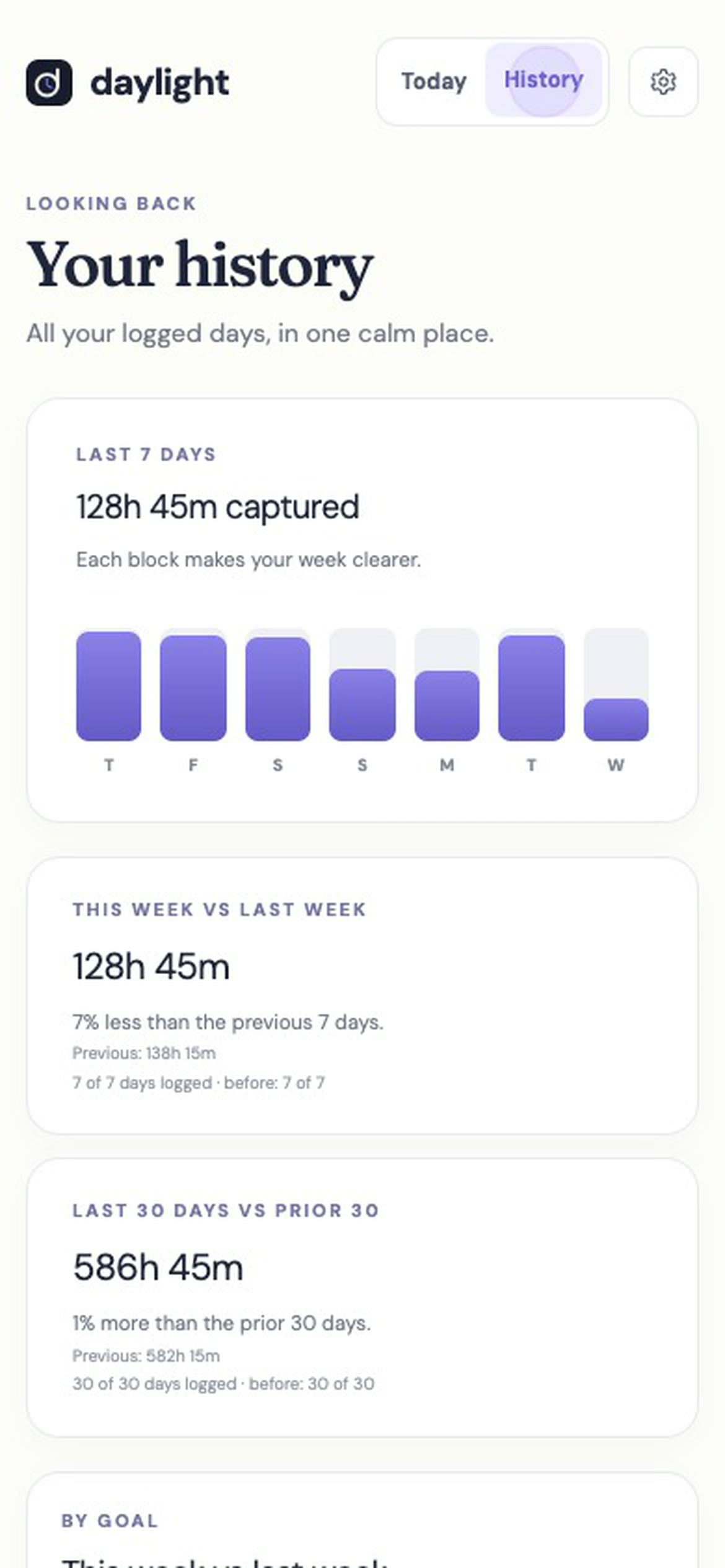
History compares this week with last week and the last 30 days with the 30 before. After the initial check, use those comparisons to review whether the changed allocation appeared in your logged hours.
Daylight Pro is $4.99 a month or $39.99 a year, plus applicable sales tax, with a 14-day free trial. There is no free plan: a valid payment method is required, and charging starts after the trial unless you cancel.
Put a small daily block in perspective
Small daily allocations can be easy to overlook; see how much 15 minutes a day adds up to over a year before choosing one to redirect.
Sources
Read November 18, 2026. The small-task examples and three-day method are original illustrations.
- BLS American Time Use Survey, Table 1 — 2025 daily activity averages, released June 25, 2026.
- BLS ATUS technical note — population, average-day definitions and main activities.
- BLS 2025 ATUS release — release date and shutdown caveat.
- Daylight home page — planning, entered time, History and trial terms.
- Daylight guide to stopping wasted time — guide structure and current subscription price.