Track hours per goal per day.
Give each time entry a goal, add the hours entered for that goal on the same day, and compare the total with its daily target. For example, 1 hour of writing plus another 45 minutes is 1.75 hours toward a 2-hour writing target, leaving 0.25 hour.
Start on the webAlso available on iPhone and Android.
How to track daily hours against a goal
Choose consistent goal names and a target period
Use the same name for related activities, such as Writing for both drafting and revising. Decide how many hours each goal gets today; keep a weekly target separate, since a two-hour daily target is different from two hours across a week.
Record the time spent under each goal
Write the date, goal, duration and a short activity description after each block. Convert minutes to decimal hours by dividing by 60: 15 minutes is 0.25 hour, 30 is 0.5 and 45 is 0.75.
Count each minute once: split an interrupted block between its activities and split an entry at midnight if it crosses into another day. Label estimates and keep forgotten time unrecorded until you can account for it.
Add entries for the same goal and date
Calculate daily goal hours = the sum of that goal’s recorded durations for that date. Preserve the separate entries so you can check a surprising total without guessing which activity caused it.
Compare the total with the intended hours
Use gap = logged hours − target hours: a negative gap means less time recorded than intended, and a positive gap means more. Before changing tomorrow’s allocation, check whether a shortfall reflects missing entries or a block that did not happen.
A worked day: entries, goal totals and targets
This fictional Monday follows three selected goals, rather than accounting for the whole day. Writing has two entries, learning has one and reading has two; all durations below are hours.
| Goal | Entries | Total | Target |
|---|---|---|---|
| Writing | 1 + 0.75 | 1.75 | 2 |
| Learning | 0.5 | 0.5 | 1 |
| Reading | 0.25 + 0.5 | 0.75 | 0.5 |
| Selected goals | 3 | 3.5 | |
Writing’s gap is 1.75 − 2 = −0.25 hour, learning’s is 0.5 − 1 = −0.5, and reading’s is 0.75 − 0.5 = +0.25. Together, the goals received 3 of their 3.5 intended hours, a half-hour shortfall.
The reading surplus does not complete the writing or learning target. Check the relevant entries separately; three recorded hours also says nothing about the rest of the day unless you log those activities too.
Keep a recorded zero distinct from an unknown period: zero means you confirmed no time went to that goal, while an incomplete log cannot support that conclusion.
What daily goal totals show over a week
Keep the same goal names across seven days and sum each column. This example carries Monday’s totals forward; the weekly targets were chosen separately to allow different allocations on different days.
| Day | Writing | Learning | Reading |
|---|---|---|---|
| Mon | 1.75 | 0.5 | 0.75 |
| Tue | 2 | 1 | 0.5 |
| Wed | 1.5 | 0.5 | 0.5 |
| Thu | 2 | 0.75 | 0.5 |
| Fri | 1.25 | 0.25 | 0.25 |
| Sat | 0.5 | 0.5 | 0.75 |
| Sun | 0.5 | 0.5 | 0.75 |
| Total (h) | 9.5 | 4 | 4 |
| Target (h) | 10 | 5 | 3.5 |
| Gap (h) | −0.5 | −1 | +0.5 |
Writing finished half an hour below target, learning one hour below and reading half an hour above. The combined 17.5 logged hours are one hour below the 18.5-hour plan, but that overall gap hides which goals missed their allocation.
Writing received at least its two-hour Monday target on Tuesday and Thursday, while the shorter Friday and weekend entries pulled its weekly total down. Check whether those shorter days were planned before treating them as a problem.
If the same hours remain available next week, moving half an hour from reading to learning would bring learning to 4.5 hours and reading to its 3.5-hour target. The remaining half hour for learning and half hour for writing need an explicit place elsewhere in the week; the totals alone do not create that time.
Hours measure time allocated, so use an activity note to record an output such as “revised introduction” when reviewing progress. For a review covering all your activities, continue with the time audit guide.
How Daylight logs time against goals
Create goals with colors and target hours, then place blocks across all 24 hours in 15-minute steps, from 15 minutes to 8 hours per block.
Daylight logs the time you enter against a goal, with an optional note, and totals your logged hours by goal. You can edit or delete an entry when you find a mistake; check those entries before interpreting a difference from your plan.
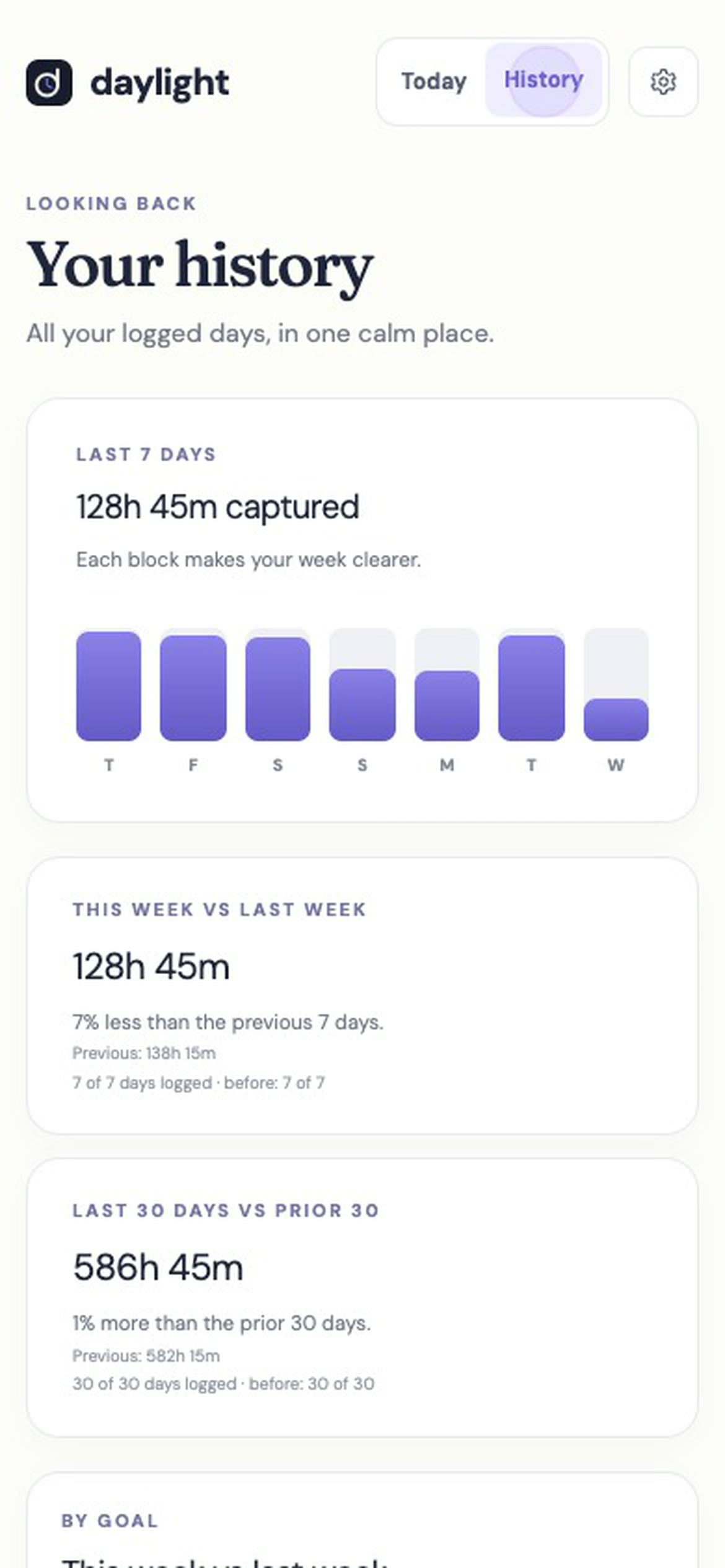
The hours you planned appear beside what happened. History compares this week with last week and the last 30 days with the 30 before, giving you period comparisons alongside your daily review.
Daylight Pro is $4.99 a month or $39.99 a year, plus applicable sales tax, with a 14-day free trial. There is no free plan: a valid payment method is required, and charging starts after the trial unless you cancel.
Sources
Read November 18, 2026. The method, daily entries and weekly calculations are original illustrations, with no population statistics or research-based performance claims.
- Daylight home page — goals, target hours, goal totals, block sizes, entered time, History and trial pricing.
- Daylight time tracking app guide — goal entries, optional notes and editing or deleting logged time.
- Daylight time blocking guide — planning workflow and subscription terms.
- Daylight guide to changing time allocations — guide structure, Sources and price line.